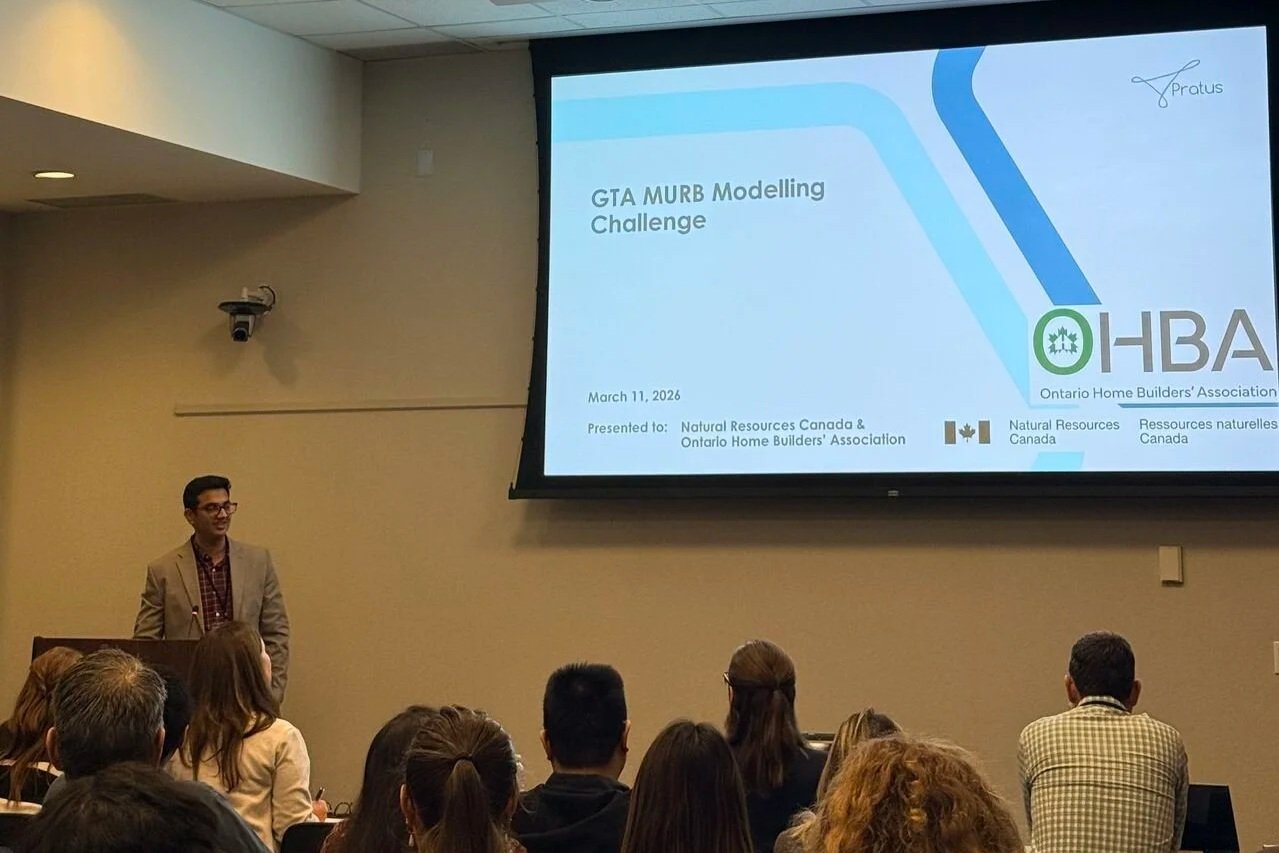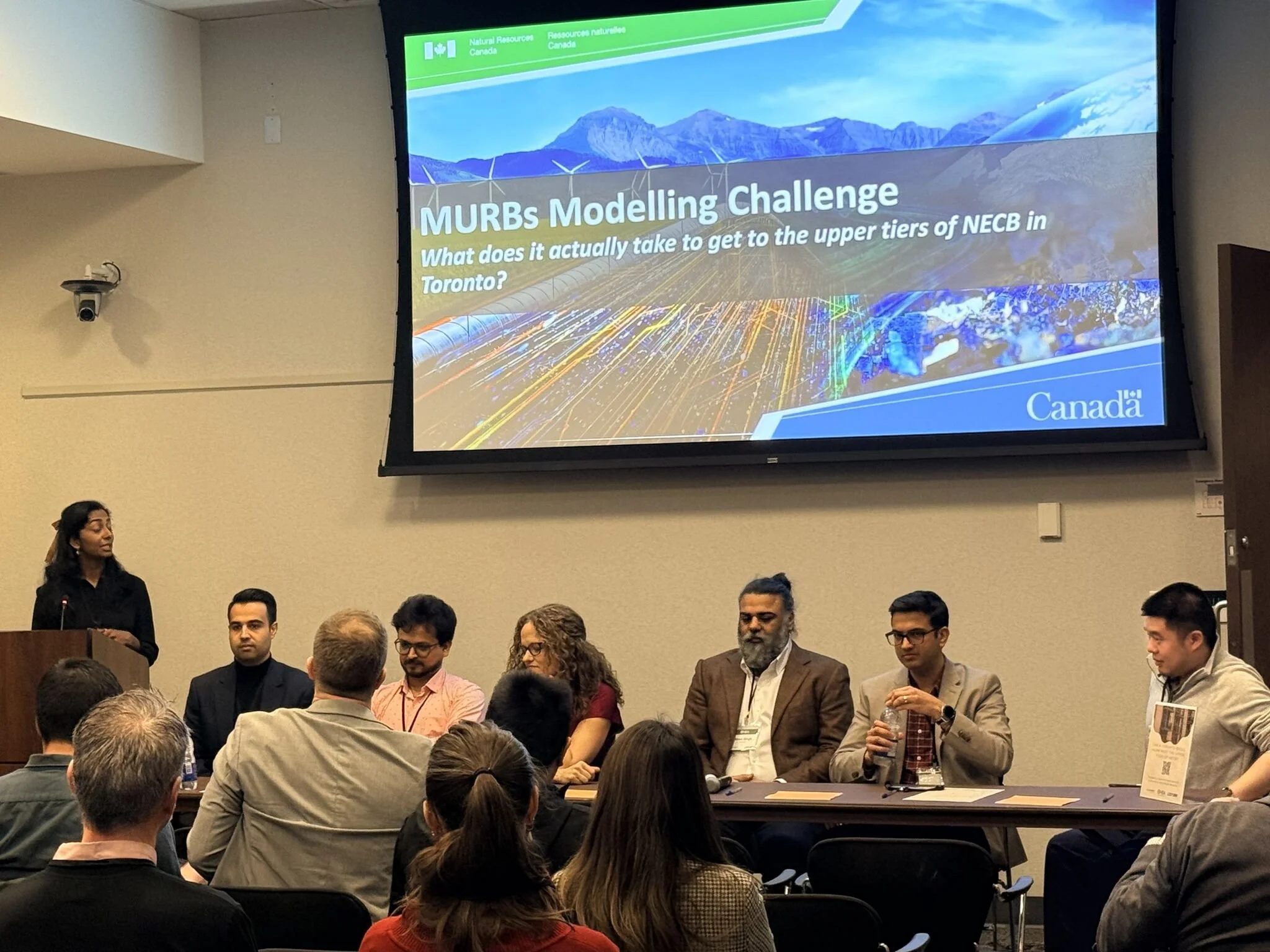

Advancing Energy Efficiency: Pratus Group Awarded Best Performance Building at Natural Resources Canada’s LEEP Challenge
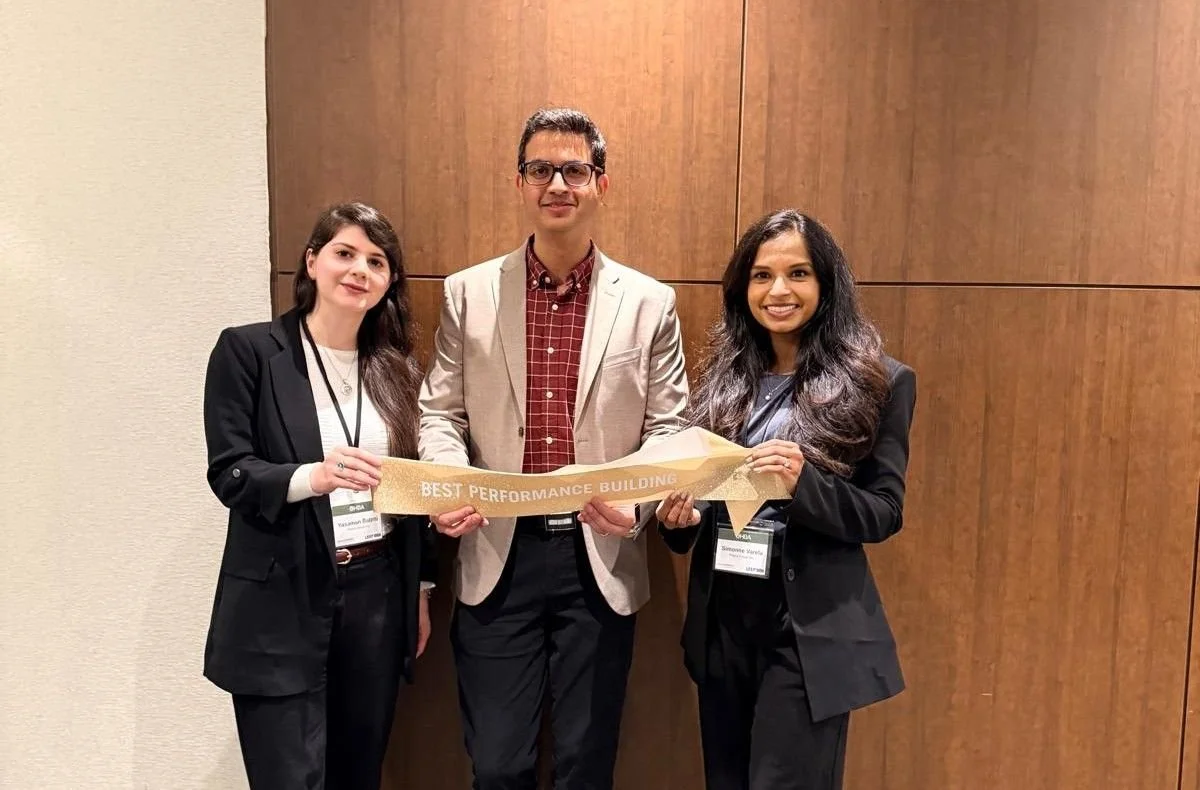
The Pratus Team: Yasamen Bateni - Modelling Lead, Jay Doshi - Sector Lead & Subject Matter Expert, and Simonne Varela - Project Manager.
Improving the energy performance of buildings across Canada requires practical insights, collaboration, and a clear understanding of how policies work in the real world.
The Natural Resources Canada (NRCan) through Local Energy Efficiency Partners (LEEP) program initiative explored how Canada’s energy codes are interpreted and applied, and what it will take to meet increasingly stringent efficiency targets.
Six energy modelling teams looked at the same building type (a typical mid-rise multi-unit residential building [MURB]) and modelled how it could achieve increasingly ambitious energy performance targets. Each team was asked to demonstrate how their approach could meet requirements based on the National Energy Code of Canada for Buildings 2020 (NECB 2020), including advanced performance tiers equivalent to Tier 3 and Tier 4.
The objective wasn’t simply to achieve the targets on paper. Instead, the challenge asked: How should builders, designers, and engineers realistically approach these requirements? By comparing modelling strategies from multiple firms, the exercise helped highlight how different interpretations of the code can lead to very different outcomes.
Rather than relying on measures that might be difficult to deliver during construction, Quasar prioritizes identifying measurable energy-saving strategies during the design phase. By defining the efficiency measures early, before construction begins, the project team can ensure compliance with performance targets without introducing unexpected costs or changes later in the process. This design-first approach reduces uncertainty and helps project teams maintain alignment between modelling assumptions and real-world construction outcomes.
Teams were also asked to present on a specialized topic related to their design approach or area of expertise. Pratus chose to highlight geothermal energy systems, one of the most efficient long-term solutions for reducing building energy use and carbon emissions.
While geothermal systems often require higher upfront investment compared to conventional systems, they provide significant operational savings over the life of a building. By evaluating performance across the entire lifecycle and not just initial construction costs, the Pratus presentation demonstrated how geothermal can deliver some of the most substantial energy reductions available for residential buildings.
Pratus was recognized with the award for Best Performance Building, reflecting the team’s holistic approach to energy efficiency, lifecycle performance, and practical implementation.